Saturday, October 17, 2015

Weaving a Chapri

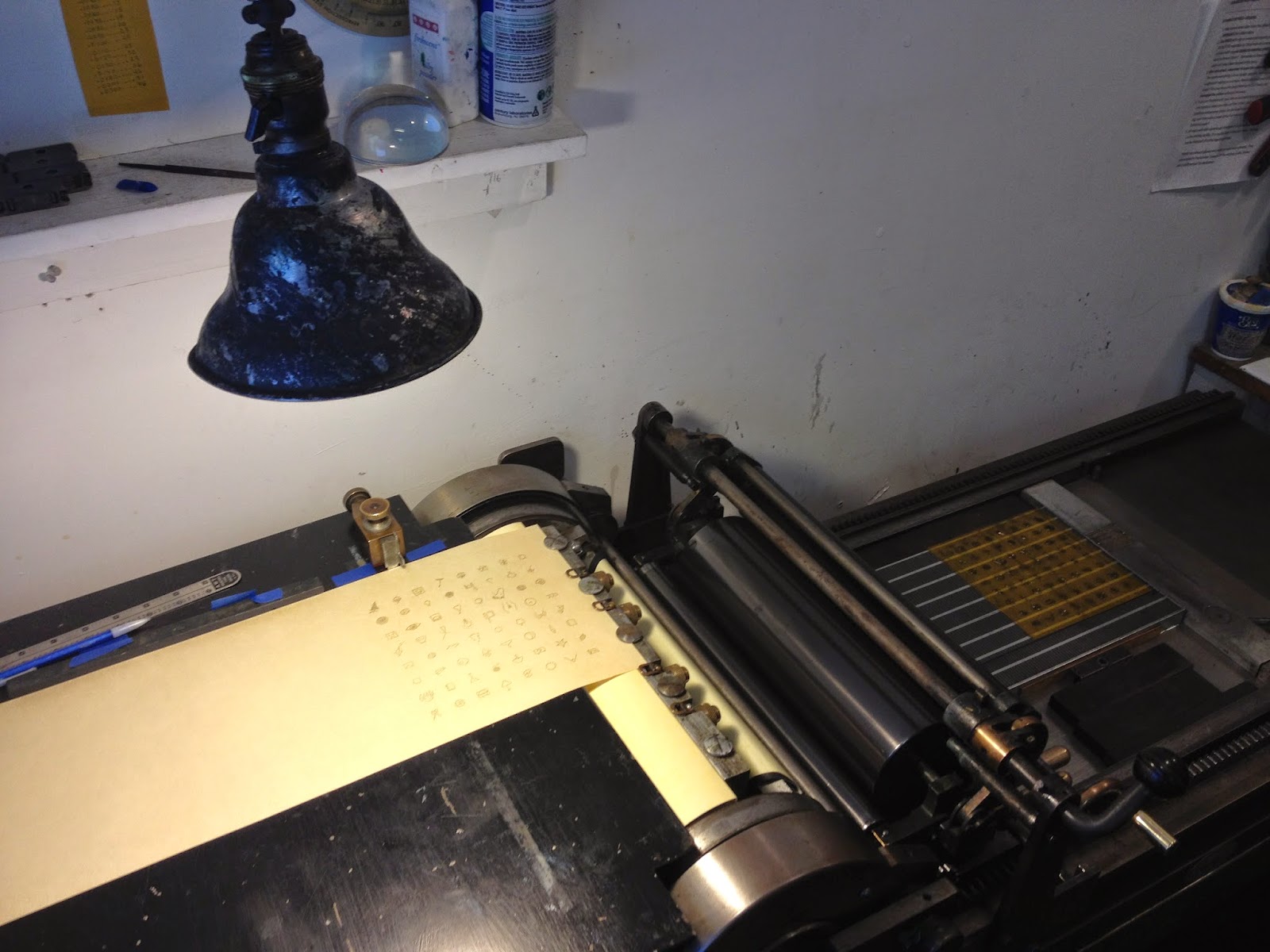
In preparation for my class at the Morgan Conservatory, I decided to weave the flexible grass mat, or chapri, used in the papermaking process. I didn't have access to the right kind of grass, so I decided to make it out of bamboo splints. After a lot of searching and consultation with Timothy Barrett as to what diameter what best, I bought packs of bamboo skewers from the local Chinese grocery store and started pulling splints to draw them down to the right diameter. 


 The process of drawing splints was long and tedious. Each one took about 10-12 minutes. In order to make a chapri 14" in length, I had to pull 266 bamboo skewers.


The jig used to weave the flexible mat was fashioned by Timothy Barrett. This particular weaving jig can be used to weave any size mat for papermaking.
 

The knot that I used to tie the fishing line used for weaving onto the bobbins was one referenced in Tim Barrett's book, Japanese Papermaking.


The bobbins I used were a good weight and were made specifically for weaving mould surafces.


I used a piece of board to the left of the jig to help align the splints during the weaving process.


Pulling the splints for weaving this chapri took about 2 months.
Weaving them into a flexible mould surface took only 3 hours!


Overall, very satisfying process. I can't wait to make more!


Friday, October 16, 2015

Islamic World Papermaking at the Morgan Conservatory

Its been a while since I posted, and that's because I was busy getting ready to move to Cleveland to start working at the Morgan Conservatory! I have now been here for about three months and its been busy, busy, busy. I started off my time here by teaching what is known in the western world as Islamic World Papermaking workshop. Of course, there is nothing Islamic about this type of papermaking, just as there is nothing Christian about western style papermaking or Buddhist about Eastern style papermaking.

We started with slides, and videos of Mohammad Hussain Kagzi making paper. You can read more about him, and his beautiful traditional handmade papers here. He sells these papers online in the US, here.


The impact of Islamic papermaking on the west is little known. During my research and time spent with the Hussain Kagzis I realized that they are a precious link to our history and provide an insight like no other. In an effort to highlight and promote their exquisite craft, skill and history, I have been giving presentations, demonstrations and now, a workshop on traditional papermaking in India or Islamic world papermaking.


The day began with a brief history, and exquisite paper samples from Mohammad Hussain Kagzi's paper unit in India. The two highly burnished papers are made by him. The white sheet of paper on the right, by me.


I had brought some fermented hemp with me which I cooked and prepared for the class. Watching over a cook and monitoring the beat was part of the first day of class.


We then had a demonstration of the papermaking technique as seen in the video of the Kagzis, and everyone was left to practice sheetforming themselves for the rest of the day.


 The vats were set up to emulate the dug-out vats that the Kagzis use in Sanganer, Rajasthan. Their way of having a slanted bottom helps use less water during sheetforming- a brilliant innovation for papermaking in the desert!


We had vats of hemp half-stuff, a cotton-abaca blend and the fermented hemp fibers to work with.


On the second day, we tried out different sizes and some brushed-on natural dye. We tried ahaar, or egg size, wheat starch size, and dye made from heads of Dahlias.


Finished sheets were burnished using bone folders on smooth wooden boards.


Tuesday, April 21, 2015

Art of the Book: Solo Show at the Experimental Art Gallery

I will be exhibiting my artist bookwork from the last 5 years at Habitat in the Experimental Arts Gallery next week.
It would be wonderful if you could make it. I will also be talking about Book Arts, and conducting workshops. Email me for more information. The workshop details are below, and the exhibition poster is attached with this email.

Hope you can make it!


2-day workshop, 25-26 April 2015
Make an Artist's Book
Decorative bookbinding and low-tech printing methods

On the first day we will learn two basic bindings and learn how to generate content for our books. Participants will learn low-tech printing and image-making methods and create imagery for their books. On the second day, we will bind these pages together to make your very own artist's book!


Date : Saturday - Sunday, 25-26 April 2015
Timings : 10 am - 1 pm on both days

Cost : Rs. 5,000 total (materials and tools included)
Venue : Experimental Arts Gallery, Habitat Center

Participants will leave with 1 completed artist's books and examples of three binding styles by the end of the second day.


Saturday, February 21, 2015

Women's Studio Workshop: Update

Lizz just posted a great article about my project with some beautiful photographs. Read all about it here and about the finished book here.


It feels like it has been snowing non-stop since I arrived


 The icicles have been building for days and look almost like they are going to become pillars!


Going for short walks after a snowfall has been something I have been enjoying.
Its also perfect time to be printing in the studio


The binding of the book I am working on has been revised and is working better- more handle-able
and able to stand up for display


I cut 50 sheets of Sakamoto and 75 sheets of Kitakata for an edition of 50 books. The barn was freeeeezing but a couple of space heaters did the job. Plus, when the board shear and guillotine are so
wonderful to work with, the cold bothers you less!


Starting on the second run of the first spread


I managed to finish up all the image runs in a couple of days


Meanwhile- I have been teaching the Art-in-Education classes


Some students really enjoyed making their paper portraits


Some are particularly fetching and simple,


And some are more complex...


 and involved


After printing all the images and the colophon, I decided to start on cutting the shapes out.
I used Mylar stencils to help with accuracy and registration


Ten down, fifty more to go!


With all the squares finished, I started on the triangles


These were harder to register, but I go them all cut finally!


And I finally finished printing the title
Now to fold, fold fold!


IAPMA Conference in Fabriano, Italy (2014)

I meant to blog about this shortly after the conference, but just couldn't find the time. I attended the IAPMA conference in Italy last summer. It was simple amazing. The spaces were beautiful. The conference was held in the papermaking and watermark museum in Fabriano which was right next to a church, where the presentations were hosted. I delivered a presentation on watermark stop-motion animation and talked about a 4-second animation I was working on for my thesis. I also gave a demonstration on Islamic-style papermaking and talked about Mohammed Hussain Kagzi and all the beautiful paper they are making India. Read more about them here.


Apart from an extensive collection of watermarks (that were hard to photograph)
the museum also had a wooden stamper


They also had a functional papermaking set up that was used to make paper (just as in the Capellades mill) as well as for demonstrations


The entrance to the courtyard was decorated with this cut paper stencil that made the
light coming through beautifully dappled


All the windows in the museum overlooked the large courtyard.
This where the demonstrations took place 

I set up an angled vat that was deep enough to simulate the dug-out vats used by the Kagzi family. It was hard to the back! Samples of their paper as well as paper from my hemp fermentation experiments were available for people to peruse
The crowd was extremely interested in the process and in the family


Amy and Roberto helped me with couching and parting!


 The church where the presentation were delivered- from the pulpit no less!