Tuesday, March 22, 2016

Florida: Paper Tour Stop 1, 2 and 3


I just returned from a wonderfully exhausting trip to Florida! I traveled there to teach, lecture and demonstrate Islamic-world papermaking techniques at the University of Florida in Gainesville, Ringling College of Art+Design in Sarasota, and the Jaffe Center for Book Arts at Florida Atlantic University in Boca Raton.
After the lecture and demo at University of Florida, I showed a few examples of paper made by Mohammed Hussain Kagzi, as well as some of my own naturally dyed samples which I recently developed. Logwoodm cochineal, black tea and yellow onion were some of the dyes that I used with and without mordants.


The class was held in the art department's printmaking area, adjacent to the letterpress print studio that is run by the wonderful Ellen Knudson. The students were engaged and interested throughout, which made teaching them a real joy.


Ellen Knudson's paper patterned beautifully with logwood and tea dyes.

  
The next stop was Ringling College of Art+Design in Sarasota, which has a small,  and beautifully organized space run by Bridget Elmer. It made me wish I lived there!


The lecture was followed by a demonstration outside the printmaking department, after which a couple of attendees got to try their hand at papermaking.


There was some time to visit with a friend and take in the beauty of a tropical environment. Made me really miss home.


The last stop was the Jaffe Center for Book Arts which operates under Florida Atlantic University. They have a great, well-lit paper studio, with a space to work outdoors, which was perfect for this class, and for the weather. Hats off to John Cutrone who single-handedly manages this space, as well as the Jaffe Collection at the library.


John generously donated Brazilwood dye for the class, a substantive dye which requires no mordant. The colours turned out beautifully!


Thursday, January 28, 2016

News


My book, Anatomia Botanica (deluxe edition) received the honourable mention as part of the 15th Carl Hertzog Award for excellence in book design.
Read more about it here:
http://news.utep.edu/?p=32056


Wednesday, January 20, 2016

Website

My new website is finally up!
The website has some information on current projects and news, as well as photos of almost all the finished projects I have worked on. It is still in progress, so please check back if some of the links don't lead you anywhere!

www.radhapandey.com


Thursday, December 10, 2015

Kata-Kata!


This week at the Morgan Conservatory I was lucky enough to attend and witness a traditional method of stenciling by hand on paper and cloth. The method is called Katazome, and it was demonstrated by two talented Katazome artists, Chie Takai and Takeshi Matsunaga, who go by Kata-Kata. They visited Cleveland especially for this event all the way from Japan. As I watched them work, I realized that I was witnessing one of those things you would never have the chance to see unless you went to Japan.


The resist is a combination of rice cake flour and rice bran mixed together
and then steamed to make a paste that is then applied.
The paste is pushed through a stencil. The stencil was traditionally made using 3 layers of persimmon dyed washi laminated with a fine gauze covered in lacquer. Before gauze, people would embed silk threads in between each sheet of washi to provide the structural integrity needed to use the piece as a stencil.  


After a few passes, the paste looks even on the surface of the cloth.


The stencil is then carefully listed off the cloth to be replaced on another part of the cloth, with perfect registration.


The cloth is stretched out using two wooden frames on either side, with nails. An elegant design, made by hand. 


These bamboo 'stretchers' are also handmade. They have thin pins that protrude from the ends. The length of the bamboo is longer that the width of the piece of cloth to be stretched.


Another elegant and simple solution.


The cloth is then suspended between two poles, and left to dry overnight.


The next day, dye was brushed onto this cloth, pretty vigorously. The dye which was used was mixed with nori or seaweed, which what I understood, prevented the dye from seeping through to the other side of the cloth.


Katazome on paper is slightly different. The rice paste is stenciled onto paper. The paper is usually made from Kozo and treated with Kon'nyaku to give it wet strength. It is also taped down to prevent warping.


I failed to tape mine down securely overnight and it warped and cracked. It relaxed after I spritzed it though, and was just fine. This is one the Kata-Kata stencils of a bear holding a salmon, which I was lucky enough to try my hand at stenciling.


The pigment that was used was powder which was mixed with soy milk, which of course was made from scratch. 


Soy beans were soaked overnight, and then pulverized in a blender and strained to produce the milk. This was mixed in with the pigment to act as the protein binder for application on paper.


The pigment can then be brushed onto the paper carefully and left to dry for half an hour between applications of colour. For rich colours, layers of pigment can be applied.


It doesn't look like much when its drying. After it is completely dry, it needs to be ironed for a few minutes on the back. This helps the colour set. When working with cloth, the cloth is steamed in a chamber to help the colour set.


The paper and/or cloth are then soaked overnight in water. The rice paste just washes away and leaves a beautiful print behind! Be sure to check out the Kata-Kata website and blog!


Thursday, November 12, 2015

Friends of Dard Hunter Conference, Banff, Canada


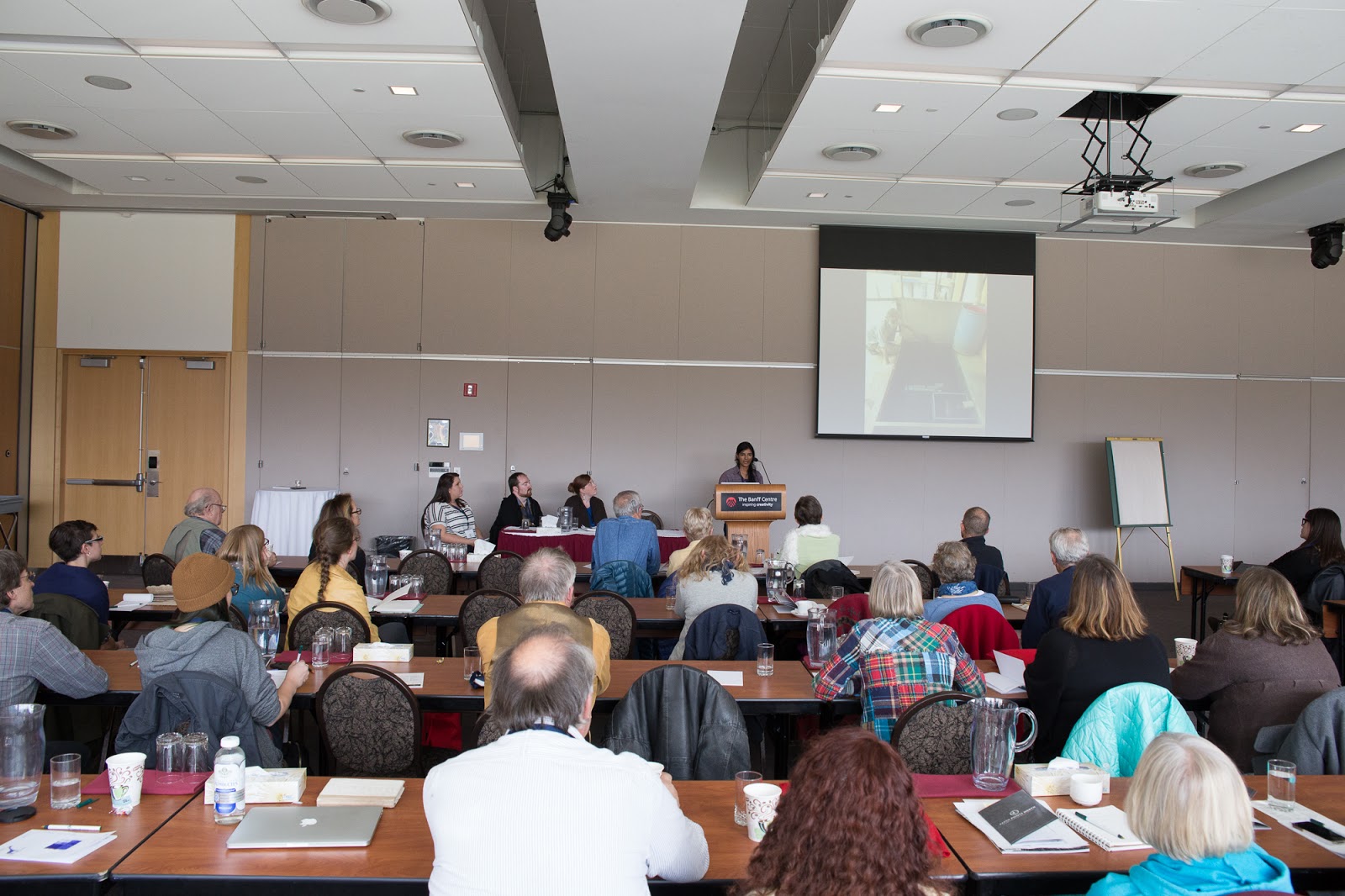
The Friends of Dard Hunter Conference this year was at Banff in Alberta, Canada. The location was the Banff Center that was in the middle (at least thats what it seemed like) of the mountains! It was hard to focus on the excellent presentations because of the generous ceiling-to-floor windows that were in every room.


I presented on Auroville Papers: An Innovation in Paper in India. I spoke about their excellent system for water filtration, and of course their work model, and beautiful paper products.

  
It was hard to focus on the actual presentation, because this is what I was looking out at!


I also gave a demonstration of Islamic World Papermaking, which I have been researching for some time now. Attendees were extremely interested in the process and the end results.


I had a table with various paper samples laid out. The two dark coloured papers you see are made by Mohammed Hussain Kagzi. He sells these traditionally made papers through his website
 as well as through this website. I also had on display, papers from my research based on traditional methods of fermenting hemp fibers for sheet formation. 


After two full back-to-back days of programming, I took a road trip with a couple of friends through Banff, and into British Colombia. Here is some beautiful frosted grass before the sun melted it away.


Here is the crystal clear Lake Louise.


The blue of this water was just remarkable...


...as well as the simply the grand scale of all the nature around us that day.